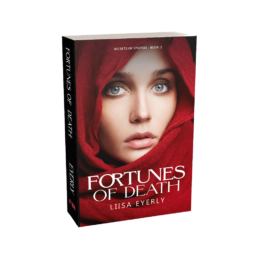
Fortunes of Death

Book club questions and resources


Obedient Unto Death

Book club questions and resources


A letter from Liisa Eyerly

Dear lovers of books,

I am ecstatic that you have chosen to spend your valuable time to read Fortunes of Death. I trust these questions will generate stimulating dialogue, exciting discoveries, thoughtful analysis, and most importantly, fun and enjoyment with your friends and fellow readers.

Fortunes of Death combines two passions, my love of mystery novels and my non-stop questioning in Bible study. Some of the characters and subplots were inspired while listening to sermons, digging up fascinating research facts, immersing myself in Turkey travel sites and videos, and crafting “What if…” scenarios.

I hope your venture into ancient Ephesus delights you with captivating characters who live, love, and die in that distant and exotic place and time.

I hope you enjoy this Fortunes of Death book club kit — Blessings, Liisa

fortunes-of-death-cover-eyes-focus

Character refresher

Sabinus Family

Sabina – daughter and sleuth

Quintus Catius Sabinus – Sabina’s father, a Roman magistrate titled Eirenarch, Guardian of the Peace.

Amisi – Sabina’s childhood nurse

Zarmig – Father’s bodyguard

Felix – family slave

Murder victim’s family and household

Dionysius Alexandros Antiochus – wealthy, elite citizen of Ephesus.

Ursula – Current wife

Paris 24-year-old surviving 2nd son from Dionysius’ 1st wife – heir

Diana – 15-year-old  daughter from 2nd wife

Titos – Ursula’s slave

Ferocianus– Slave gladiator, 18 yr. old captured Dacian (Romania) fighter war (89) now 25 yrs old.

Pelopidas Antiochus– deceased great-grandfather

Suspects family

Yechiel (ben Jonah )  Architect working for Dionysius on his library

Eunice -Yechiel’s wife

Reuben – Eunice’s uncle

Benjamin -Yechiel’s deceased brother

Sabina’s church family

Apollos – Bishop of the local church

Apostle John – disciple of Jesus

Portia (Nicia) – friend of Sabina

Horace (Nicia)  Portia’s husband

Assorted others

Loukas Rhodisius – Dio’s Banker friend

Agabus – competing architect

Mordax – ex-gladiator, adoptive father to Mordax, criminal

Otho –Paris’s friend and Diana’s fiancé

Cassandra – fortune teller, pythoness

Gnaeus Gratus – Dionysius’s lawyer

Flavius Fortunus – magistrate of religious observances, Sabina’s father’s nemesis

Vocabulary

Adonai: Hebrew word for Lord.

aediles: Roman magistrate responsible for public programs and buildings.

agora: a public open space used for assemblies and markets.

atrium: central court with rooms off of it.

caldarium: a very hot steamy room heated by a hypocaust, an underfloor heating system using tunnels with hot air, heated by a furnace tended by slaves. This was the hottest room in the regular sequence of bathing rooms.

carpentum: a bus or limousine of wealthy Romans. It had four wheels, a wooden arched rooftop, and was comfortable and spacious.

daemon: a supernatural being of a nature between gods and humans.

denarius: Roman coin.

equestrian: second highest social class.

frigidarium: room with a swimming pool filled with cold water used for cold-water baths and swimming.

Hispania: Roman province including Spain and Portugal.

impluvium: open roof with a pool underneath to catch rainwater.

lanista: trainer of gladiators.

litter: open or covered chairs or beds carried by two or more carriers to transport people.

ludus: (plural ludi) A gladiator training school; public games

held for the entertainment of the Roman people.

mantle or palla: loose sleeveless cloak or shawl.

manumission: the act of freeing slaves by their owners.

necropolis: cemetery.

nymphaeum: a grotto or shrine. dedicated to nymphs. Can incorporate water.

pantomimes: dramatic entertainment in which performers express meaning through gestures accompanied by music.

paterfamilias: male head of the family.

peristyle: a row of columns. surrounding a space within a building such as a court or internal garden.

plebian: a commoner.

pulse: an army staple of cooked wheat grains mixed with water, salt, fat, and olive oil or milk.

pythoness: female soothsayer, fortune teller or conjuror of spirits.

retiarius: gladiator armed with a net and a spear.

sestertius: Roman coin.

stela, stele: a carved or inscribed stone slab or pillar used for commemorative purposes.

stola: traditional female garment, corresponding to the togas worn by men.

strigil: curved blade used to scrape sweat and dirt from the skin after exercise.

toga: loose flowing outer garment worn by citizens of ancient Rome.

tunic: sleeveless garment reaching to

Yeshua: Hebrew name for Jesus.

©Copyright 2022-2026 Liisa Eyerly.


©Copyright 2022-2024 Liisa Eyerly.